Baby Vision Development: What Newborns and 2-Month-Olds See, When They Focus, and How to Help
The first time your baby seems to lock eyes with you can feel almost electric. One week they appear to gaze somewhere beyond your shoulder; the next, they seem to study your face with real purpose. Baby vision changes quickly in those early months, moving from a blurry, high-contrast view of the world to a more colourful, coordinated experience.
Understanding baby vision development can make everyday moments, from feeding to a stroll around the block, feel even more fascinating. It also gives you a practical way to notice whether your little one is reaching their early visual milestones.
What Do Newborns See?
Newborn vision is not like adult vision. At birth, babies can see, but their view is fuzzy and limited. They are especially drawn to bold outlines, light-and-dark patterns, and the human face. That makes sense: faces have strong contrast around the eyes, hairline, and mouth.
In the first few weeks, your baby sees best at roughly 20 to 30 cm away, about the distance between your face and theirs during a feed or cuddle. So when you lean in close and chat, they may be taking in far more than you realise.
If you have ever wondered, “What do newborns see?”, picture a world made mostly of blurred shapes, shadowy edges, and strong contrasts. Fine details and distant objects are hard for them to make out. Their eyes are still learning how to focus, work together, and respond to movement.
What Does a 2-Month-Old See?
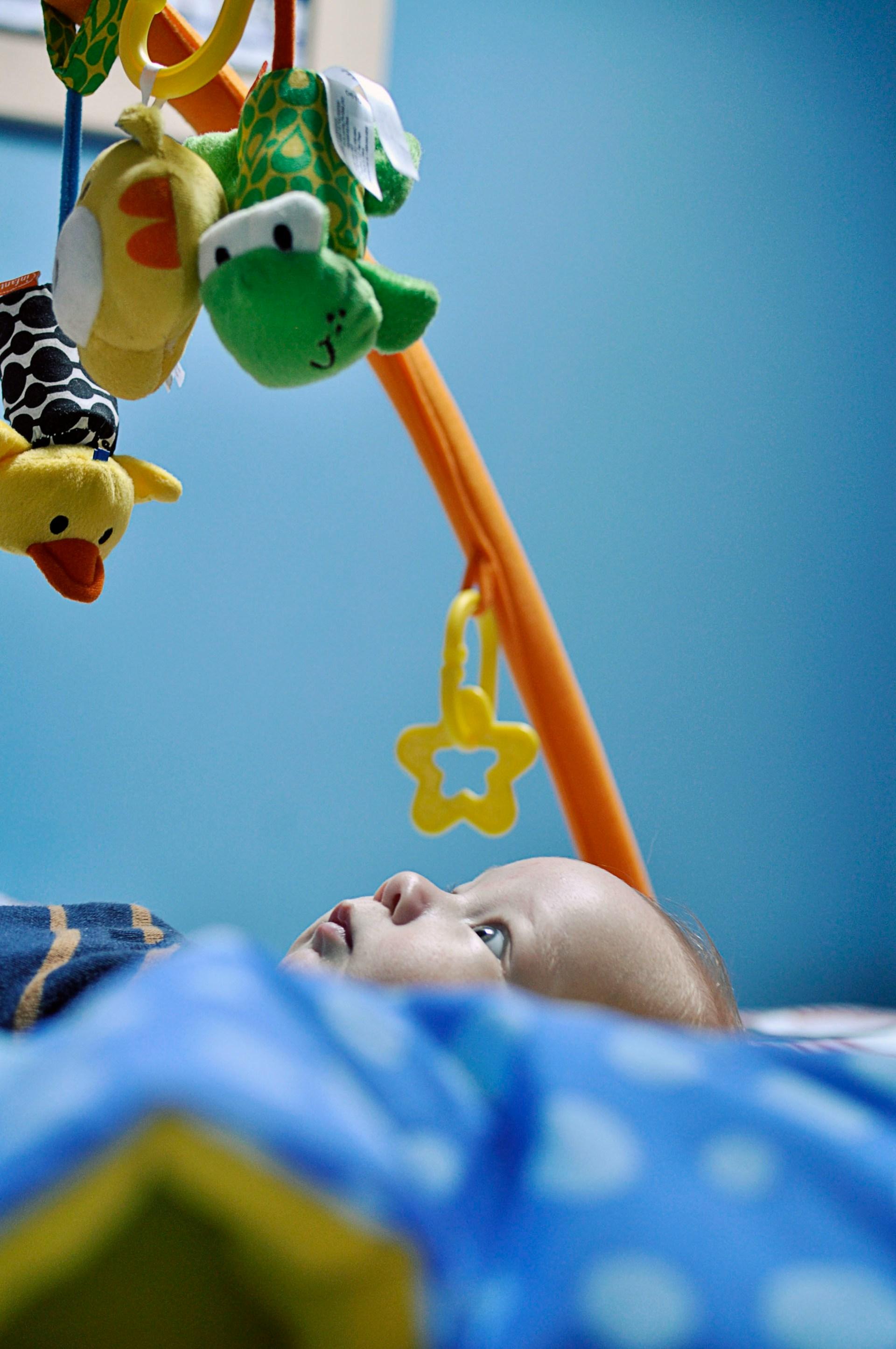
By around 7 to 8 weeks, baby vision takes a noticeable step forward. Many babies can focus more clearly at about 20 to 40 cm, and they are beginning to notice things farther away too. That bright window across the room, the family dog walking by, or a mobile above the cot may suddenly become more interesting.
This is often when parents start asking, “When can babies focus?” The answer is not a single date, because every baby develops at their own pace. Still, by two months, your baby should be showing more deliberate visual attention than they did as a newborn.
At this stage, your baby may:
- Fix their gaze on your face for several seconds
- Watch you move around nearby
- Notice a familiar toy or patterned blanket
- Begin following a slowly moving object with their eyes
- Show interest in light, windows, or moving shadows
Their focus is not perfect yet. A baby might follow a toy for a moment, look away, then find it again. That is normal. Looking takes effort.
Focusing and Tracking: A Big Leap at 7 to 8 Weeks
One of the loveliest visual milestones 0-3 months is tracking. Around 7 to 8 weeks, many babies can follow a moving object more smoothly than before.
Early on, their eyes may jump from place to place. Then the motion becomes more coordinated. They can often track an object from left to right, moving it past the middle of their visual field, also called the midline. Soon after, they begin practising vertical tracking too, following something moving up and down.
So, when do babies follow objects? Often, the first signs appear during the second month. By around three months, most babies can follow a slow-moving face or toy through a broader range of motion.
How Do Babies Track Objects?
Tracking is a team effort between the eyes and brain. Your baby has to notice the object, focus on it, predict its movement, and move both eyes together. Quite a workout for such a small person.
Try holding a simple toy about 20 to 30 cm from your baby’s face. Wait until they are looking at it, then move it slowly from one side to the other. Slow is the key. Think gentle turtle, not flying aeroplane.
If your baby loses interest, stop. A turned head, fussing, yawning, or looking away can mean they have had enough visual input for now.
When Do Babies See Colour?
Colour vision develops in stages. At birth, babies are most responsive to black, white, and high-contrast patterns. They may see some colour, but it is not as vivid or well organised as it will become.
The infant color vision timeline generally looks like this:
- At birth: Babies are most interested in black, white, and strong contrast. Bold stripes, checkerboards, and simple face-like images are easy to notice.
- By 6 to 8 weeks: Many babies begin distinguishing red first, followed by orange and then yellow.
- By 3 to 4 months: Most babies can see across the full colour spectrum, with colour perception becoming richer and more reliable.
That answers another common question: when do babies see color? Colour is present early, but it becomes more meaningful over the first few months. A bright red rattle may grab your two-month-old’s attention more effectively than a pale grey one.
You do not need a nursery filled with rainbow toys, though. A few visually clear objects are plenty. Babies also love looking at real-life colour: green leaves outside the window, a blue kitchen mug, the pattern on your shirt.
Depth Perception in Infants: Learning What Is Near and Far
Depth perception in infants is very limited at first. A newborn cannot accurately judge whether an object is close, far away, or moving toward them in the way an older child or adult can.
This skill depends partly on binocular vision, which means both eyes working together to create one image. Binocular vision usually begins developing around 2 to 3 months. As the eyes become better aligned, your baby gradually gains a stronger sense of distance and space.
This does not happen overnight. For a while, your baby may reach toward a toy and miss, or stare at something without seeming sure of where it is. That is part of the process.
Their growing depth perception supports later skills such as reaching, grasping, rolling toward a toy, and eventually crawling. Vision and movement are closely linked. One feeds the other.
Simple Ways to Help Baby Focus and Track
You do not need special equipment to help baby focus and track. Your face, your voice, and a few everyday objects offer more than enough practice.
Start With High Contrast, Then Add Colour
For a young newborn, choose black-and-white cards, bold geometric patterns, or books with clear images. Hold them close, around 20 to 30 cm away.
As your baby approaches 6 to 8 weeks and begins showing more interest, bring in colourful objects. Red, orange, and yellow toys can be particularly eye-catching during this period. By three or four months, offer a wider range of colours.
Move Toys Slowly in Arcs and Circles
Hold a toy where your baby can see it, then move it gently:
- From left to right
- Back toward the centre
- Slowly up and down
- In a broad arc
- In a small circle once tracking is becoming smoother
Pause occasionally so your baby can find the toy again. Fast movement can be frustrating, while slow movement gives their eyes time to coordinate.
Explore Different Distances
Begin with the toy close to your baby’s face, within that comfortable 20 to 40 cm range. Once they are looking, gradually move it a little farther away.
This small game helps them practise shifting focus. Keep the movement smooth and do not move the toy too far too quickly. At this age, a distant object may still be blurry.
Change the View
Babies learn from variety. Spend time together in different rooms, sit near a window, or let your baby look at tree branches moving outside. On walks, change the direction your baby faces in the stroller when it is safe and appropriate.
Even a change of scenery across the living room can be interesting. New light, different shapes, another ceiling fan. Tiny things, huge discoveries.
Developmental Signs to Watch For
Watching your baby’s visual progress is not about testing them every day. It is simply noticing how they engage with the world.
By about 7 to 8 weeks, ask yourself:
- Can my baby briefly fix their gaze on my face?
- Do they follow a slow-moving toy or face from side to side?
- Are they beginning to watch objects beyond the close feeding distance?
- Do new visual stimuli, such as a patterned card or bright toy, catch their attention?
- Do both eyes usually appear to move together?
Some days will be more alert than others. A hungry, tired, or overstimulated baby may not be interested in tracking anything. Try again after a feed or nap, when they are calm and awake.
When to Talk to Your Paediatrician
Most differences in early baby vision are harmless and temporary, but it is sensible to raise concerns early. Trust your instincts. You know your baby best.
Speak with your paediatrician or health visitor if your baby:
- Does not fix their gaze on faces by 8 weeks
- Does not track a slow-moving object by 3 months
- Has one eye that consistently turns in or out after 4 months
- Rarely seems interested in lights, faces, or visual movement
- Has eyes that appear cloudy, unusually red, swollen, or constantly watery
It is common for newborn eyes to wander or briefly look crossed, especially when they are tired. Their eye muscles are still developing. But a persistent eye turn after four months deserves a professional check.
Those early gazes are more than sweet little moments. They are your baby learning to recognise you, understand movement, and make sense of a bright new world.
We as the developers of the Erby app disclaim any liability for any decisions you make based on this information, which is provided for general informational purposes only and is not a substitute for personal medical advice.