Play with Your 1-Month-Old: Gentle Games to Support Visual, Motor, Auditory, and Social Development
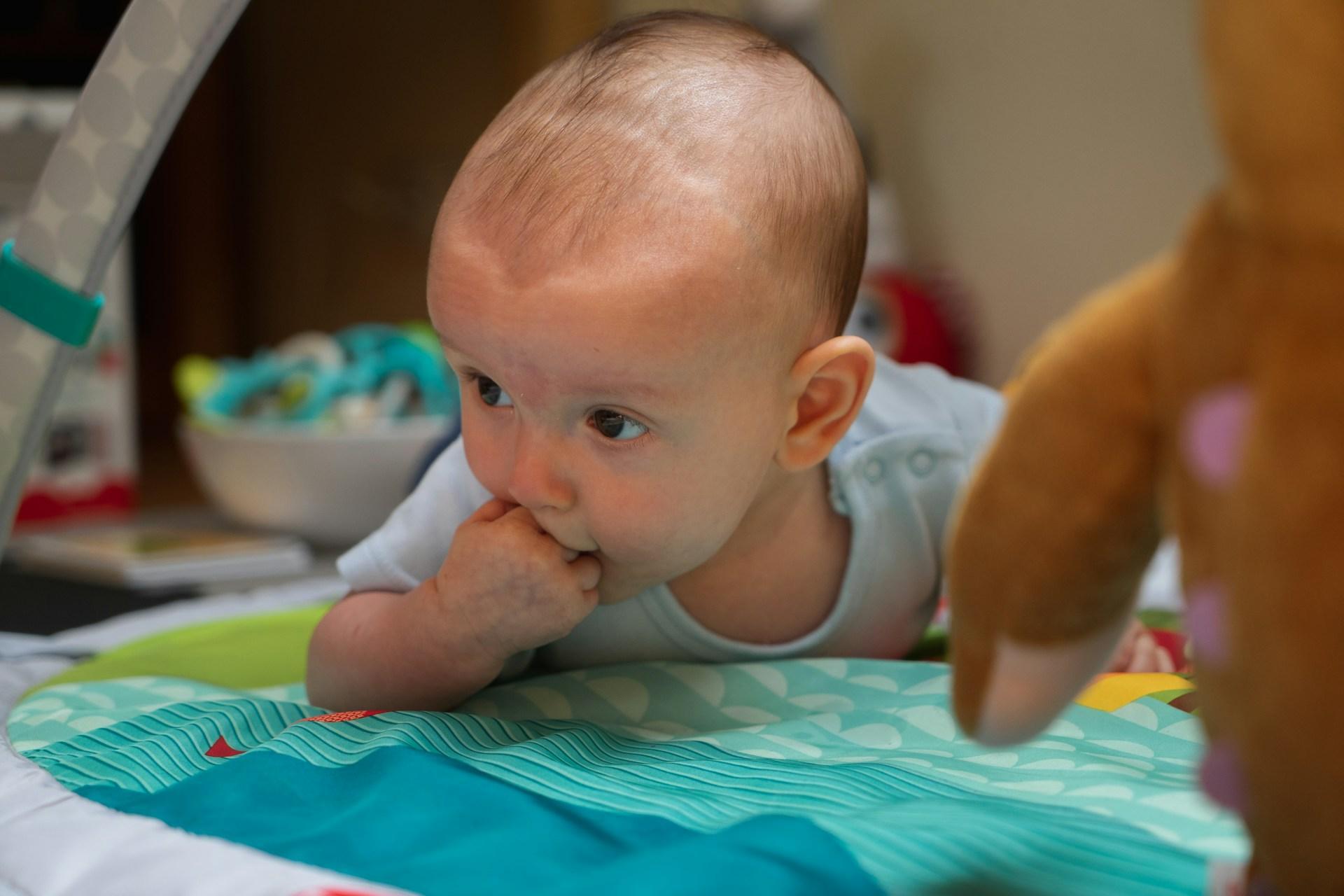
Your baby is one month old, a tiny human still adjusting to the bright, busy world. You’re adjusting too. Here’s the lovely surprise waiting for you this month: those sleepy newborn days are starting to open up into little pockets of alertness. Short windows, yes. But in those minutes, there’s magic. You can absolutely play together now. It won’t look like board games or building blocks. It will look like eyes meeting, little sounds back and forth, and simple newborn activities that feel like connection, not a lesson.
What’s changed at 1 month
- Your baby has longer alert periods, usually about 15 to 20 minutes at a time. Some days, it’s a little more, other days it’s less. Totally normal.
- Focus is better. You might notice your baby paying attention to your face, a black and white pattern, or a slow moving object about 8 to 12 inches from their eyes.
- Early social responses are peeking through. A quiet pause when you talk. A tiny smile. A turn toward your voice. It’s the very beginning of social play and it’s wonderful to watch.
These small shifts open the door to simple baby games that support 1 month old development without pressure. Think gentle, short, and playful.
A quick mindset reset about newborn play
Play at this age is not performance. It’s presence.
- Keep it short. Follow your baby’s cues. If their gaze turns away, if they arch or fuss, that means “I’m done.” Try again later.
- Every interaction counts as play at this age. Diaper changes. Feeding cuddles. A funny face. Singing while you sway. All of it builds your baby’s brain.
- No screen time. Your voice and face provide the richest newborn sensory activities. That’s more than enough.
- Variety helps, but repetition is comforting. Your baby loves hearing the same simple tune and seeing the same shapes again and again.
Ready to try some easy baby activities? Let’s break them down by developmental area so you can pick what fits each little awake window.
VISUAL: Simple ways to support focus and tracking
At one month, visual stimulation for a newborn is all about high contrast, slow movement, and your face. Keep objects close, around the length of your forearm.
Track a face or colorful toy in a slow arc
Your face is your baby’s favorite thing to look at. Sit so your faces are about 8 to 12 inches apart. Catch their gaze, smile, then slowly move your face or a colorful toy in a gentle arc from one side to the other.
- Move slowly, like the second hand on a clock. Pause in the middle for a beat, then continue.
- If you use a toy, pick one with high contrast or a bold red detail. Keep it still for a moment, then shift a little to let your baby “re-find” it.
- Stop when your baby looks away or blinks rapidly. That means “break time.”
This kind of tracking is one of the most effective games for a 1 month old. You are helping the eyes work together, which lays groundwork for later reading and hand-eye coordination.
Hang a high-contrast mobile
A simple mobile for a newborn baby can be a quiet visual treat. Look for one with black and white shapes or strong patterns. Hang it securely so it is well out of reach and not directly over the center of the crib where your baby sleeps. Over the changing area or a supervised play spot works well.
- Place the mobile about 12 to 16 inches away from where your baby will lie.
- Choose few elements, strong contrast, slow movement. Too many dangling bits can be overwhelming.
- Rotate the angle every few days to give a fresh view.
This counts as visual stimulation for a newborn while you take a quick breath, drink water, or sing along.
Try black, red, and white cards
High-contrast cards are classic newborn sensory activities for a reason. At this age, bold stripes, simple shapes, and strong edges pop. Many babies also begin to distinguish red earlier than other colors, so black-red-white cards are perfect.
- Hold a card 8 to 10 inches from your baby’s eyes.
- Keep it still for several seconds, then slide it a tiny bit to the right or left.
- Swap to a new card if they stay engaged. Or just keep the favorite card in view.
You can buy black and white cards for a newborn, or make your own with index cards and a marker. Circles, stripes, checkerboards. Easy.
AUDITORY: Fill their world with friendly sound
Newborns tune into melody, rhythm, and your familiar voice. Auditory stimulation for a newborn should be gentle and repetitive. You’ve got all you need already.
Sing simple, repetitive melodies
There is huge comfort in a steady tune. Lullabies, folk songs, even a made-up ditty about socks. The melody matters more than the words. A 2020 study from the University of Washington’s I-LABS found that “parentese” - that sing-song voice many adults naturally use with babies - helps infants pay attention and supports early language learning.
- Pick one or two songs and repeat them often. Repetition builds recognition.
- Slow down and exaggerate the rhythm. Smile as you sing, and pause now and then to let your baby “answer” with a sigh or coo.
- Try call and response: “La-la-la…” then wait. Any little sound back? That counts.
Singing to your baby has benefits that last well beyond this month: smoother soothing, richer vocabulary exposure, and a calm rhythm that can settle both of you.
Rattle from different sides
A soft rattle or a crinkly cloth works beautifully. Hold it near your baby’s ear on one side, give a gentle shake, then pause. Watch. Many 1 month olds will try to turn toward the sound.
- Keep the sound gentle and the session brief.
- Alternate sides to encourage equal attention.
- If your baby startles, lower the volume and move the rattle a little farther away.
This is one of those classic baby games that looks tiny but trains the brain to locate sound in space.
Play soft music during awake time
Short bursts of calm music can make tummy time feel cozier or create a cue for play. Stick to a comfortable volume - if you need to raise your voice to talk, it’s too loud.
- Choose instrumental or simple vocals with a steady beat.
- Keep it to a song or two, then enjoy some quiet so your baby’s ears can rest.
MOTOR: Gentle moves for a growing body
At one month, movement is about small experiences that build strength safely. Your baby doesn’t need gear or fancy setups. Just you, a comfy floor, and a few minutes.
Tummy time, 15 to 20 minutes total per day
Aim for 15 to 20 minutes of tummy time across the whole day. Short bursts work best - think 3 to 5 minutes, several times. The floor is great, but your chest counts too.
- Place your baby on a firm, clean surface. Roll a small towel under the chest for a mini boost if needed.
- Get face to face. Sing, show a black and white card, or tap the mat gently.
- If they fuss, try a different position: on your chest while you recline, or across your forearm for a brief “airplane” carry.
- Stop when done, try again later. Progress is often one minute at a time.
Tummy time is one of the top activities for a 1 month old. It builds neck, shoulder, and core strength that will help with rolling and crawling later.
Hold hands and cycle the legs
Lie your baby on their back. Gently take their hands and guide a mini “sit-up” just an inch, then back down. Follow with slow bicycle legs. Think smooth, not fast.
- This simple newborn play helps coordination.
- Cycling can ease gas too. If your baby is gassy, softly press the knees toward the tummy for a second, then release.
Let baby push against your hands
While your baby lies on their back, place your palms against the soles of their feet. Offer a steady surface so they can push. Many babies love that springy feeling.
- Keep your hands firm but gentle.
- Count a few pushes out loud to make it a little game.
These motor baby activities do not need to be long. A minute here and there is perfect.
SOCIAL: Tiny conversations, big connection
Your baby is a social learner already. Games for a 1 month old are mostly about faces, voices, and taking turns. Nothing fancy. Everything warm.
The imitation game
Get close, soften your voice, and make one exaggerated expression: wide eyes, a slow tongue-out, a big “O” mouth. Pause. Wait. Your baby may watch closely and then try to echo you in their own way.
- Hold the pose a couple of seconds to give them time to process.
- Keep it playful. If you feel silly, you’re doing it right.
Take turns with sounds
When your baby makes a noise, stop and “answer.” Echo their sound or respond with a simple “Hi, I hear you.” Then wait for a reply. That back and forth is how conversation starts.
- Match the pitch and rhythm they use.
- Celebrate the tiniest coo. You’re building the architecture of communication one turn at a time.
Peek-a-boo with a cloth, very simple
Hold a light swaddle or washcloth between your faces for just a second, then drop it with a smile: “There you are!” At this age, keep it slow and short.
- Avoid covering your baby’s face. You want them to see you appear, not feel blocked.
- Two or three rounds is plenty.
These social newborn activities help your baby link “I do something” with “you respond.” That sense of being seen is the heart of early learning.
A sample flow for a 15 to 20 minute awake window
Every baby is different, so treat this like a menu, not a script.
- Wake and cuddle, 2 minutes. Soft “good mornings,” a quick song.
- Diaper change, 3 minutes. Hang a high-contrast card nearby so your baby can glance at it while you chat.
- Tummy time, 3 minutes. Place your baby on a mat, face to face. Sing your favorite lullaby or play soft music. Try one black-red-white card at eye level.
- Visual tracking, 2 minutes. Roll to back. Slowly move a colorful toy in a small arc.
- Rattle turn-taking, 1 to 2 minutes. Gentle shake on the left, then the right. Pause and smile.
- Social game, 2 minutes. Make a big “O” mouth, wait, then mirror any little movement back.
- Feed or nap. You did it.
That’s it. Short, sweet, connected.
Quick answers to common questions
- How often should we play? As often as your baby is alert and calm. Most 1 month olds have wake windows of around 15 to 20 minutes. Even two minutes of eye contact is valuable.
- Do I need special toys? Not really. Your face, voice, a soft rattle, and a couple of high-contrast cards go a long way. A simple mobile for a newborn baby is a nice extra but not required.
- What if my baby looks away? That is a built-in reset button. Give a break, lower stimulation, try again later.
- Is screen time ever OK? Not at this age. Real-life faces and sounds are richer and better suited to newborn development.
- What if my baby doesn’t seem to track or respond yet? Many babies take a little longer. Keep sessions brief and consistent. If you’re concerned, bring it up at your next pediatric visit.
Bringing it all together
You do not need a perfect routine or an overflowing basket of toys to figure out how to play with a newborn. Think tiny moments. Think repeatable. Think “connection over instruction.” The best baby activities at one month look like this:
- Visual: slow tracking, high-contrast views, black and white cards for a newborn with a splash of red.
- Auditory: singing with easy melodies, gentle rattles from side to side, short stretches of soft music.
- Motor: tummy time spread across the day, bicycle legs for comfort and coordination, feet pushing against your hands.
- Social: imitation, turn-taking with sounds, a very simple peek-a-boo with a cloth.
You’ll find your rhythm. Some days you’ll do all of it. Other days, you’ll do one song and a smile and call it good. Both are right. These newborn games are not just about 1 month old development. They’re about anchoring your baby in the world with your voice, your eyes, your touch. That’s the real work. And the real joy.
We as the developers of the Erby app disclaim any liability for any decisions you make based on this information, which is provided for general informational purposes only and is not a substitute for personal medical advice.