What to Expect at 6 Weeks: Baby Milestones, Tummy Time, Vision and Smiles
The 6-week mark catches many new parents by surprise. Your baby is still tiny, but suddenly they seem more awake, more alert, a little bit more like… a person. This is often when you start to notice clear baby milestones, and you might find yourself wondering: Is this normal? What can a 6 week old do? What should I be looking out for?
Let’s walk through what usually happens with baby development around 6 weeks, what you might see day to day, and when it can be helpful to chat with your GP or health visitor. Every baby is different, of course, but there are common 6 week milestones that most babies gradually move towards in their own time.
Physical development at 6 weeks
At this age, your baby’s body is changing quickly. If you look back at photos from the first week, they may already look much less “newborn” and a bit more filled out.
Head control at 6 weeks: tummy time progress
Head control is one of the big physical baby milestones around now.
By about 6 weeks:
- Many babies can briefly lift their head to around 45 degrees during tummy time.
- Some can turn their head to one side while lifting it.
- Neck muscles are stronger, although still wobbly and easily tired.
You might notice during tummy time that your baby pushes into the surface a little, their chest coming slightly off the mat, with their head bobbing up for a second or two. That is exactly what we expect with tummy time at 6 weeks.
A few tips to support head control at 6 weeks:
- Keep sessions short and frequent. 3 to 5 minutes several times a day is often better than one long stint.
- Try different positions. On your chest while you are reclined, over your lap, or on a firm play mat.
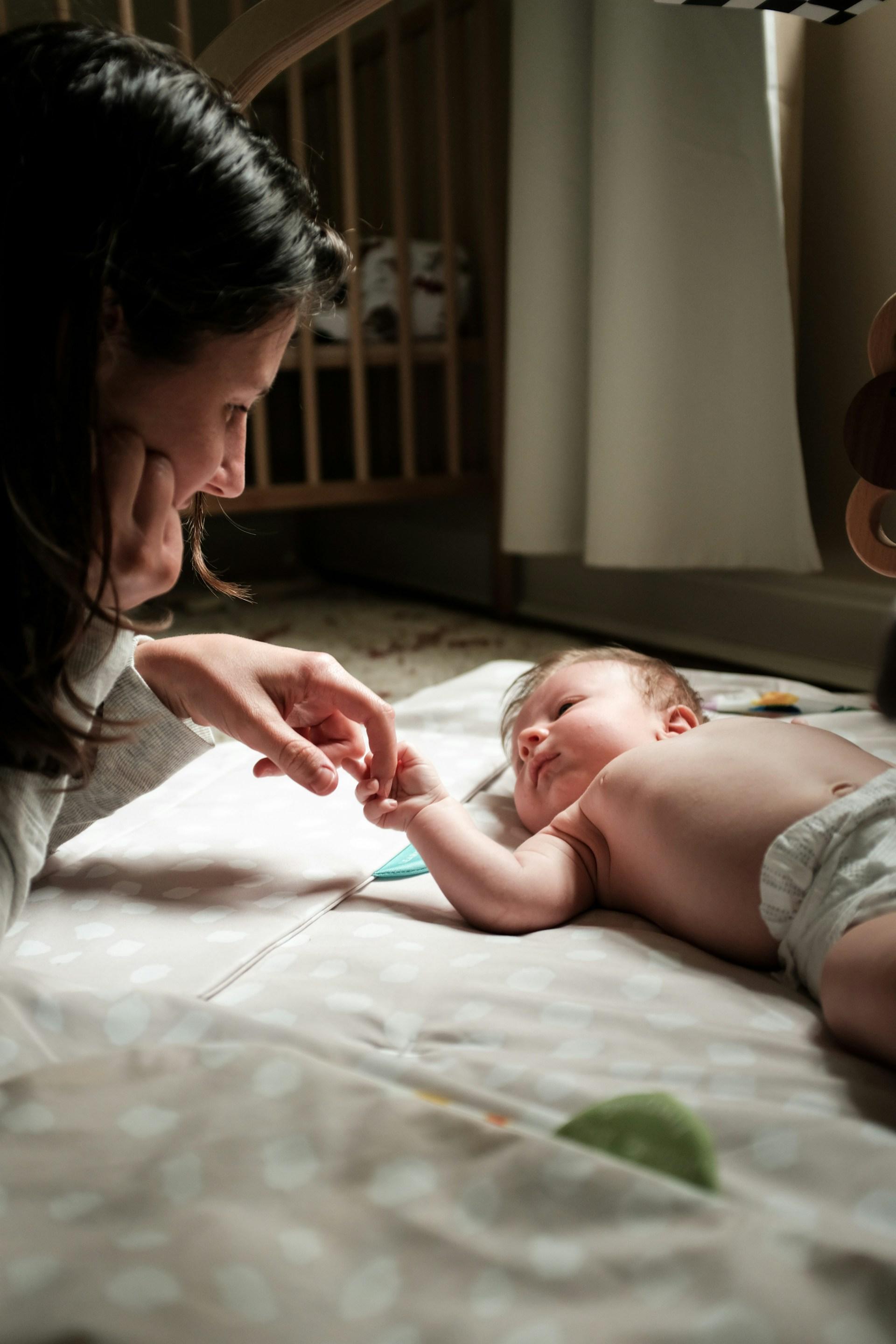
- Get down to their level. Lie in front of them so they can see your face. Talk, sing, or make gentle sounds to encourage them to look up.
If your baby really dislikes tummy time, you are not alone. Many 6 week old babies complain loudly. You can start with just a minute or two, a few times a day, and slowly build up. Even very short bursts still help neck and shoulder strength and support overall newborn development.
Pushing up on forearms
Around 6 weeks, some babies begin to push up slightly on their forearms while on their tummy. This might not be a big push yet – just a gentle lift where the elbows move under the shoulders and the shoulders come a bit forward.
Think of it as your baby exploring:
- “What happens if I push here?”
- “Can I move my head more if I lift my chest a bit?”
This early upper body strength is part of the long chain of baby development that eventually leads to rolling, sitting, crawling and pulling to stand.
If your baby is not pushing up yet, that can still be normal at this age. The 6 week milestones checklist is a guide, not a test. Simply keep offering daily tummy time and lots of safe floor play.
Smoother arm and leg movements
Remember those jerky, startling arm flings in the first couple of weeks? By 6 weeks, many babies move their arms and legs more smoothly.
You may notice:
- Arms moving in gentle circles rather than sharp flails.
- Legs kicking in a more rhythmic way.
- Hands sometimes coming to their mouth intentionally.
These smoother movements show that your baby’s nervous system is maturing and that they are starting to gain a tiny bit more control over their body.
This is a lovely time to:
- Let baby kick with bare legs on a soft blanket.
- Offer a lightweight rattle or soft toy placed in their hand so they can accidentally “shake” it.
- Play simple games like bicycling their legs while talking or singing.
All of this counts as play, plus it helps you tune into your baby’s 6 week old development signs.
6 week baby weight gain: what is typical?
By around 6 weeks, many babies have gained roughly 1 to 1.5 kg (about 2 to 3 lb) since birth. Some gain more, some less. Growth is not perfectly steady either, so you might see periods where they seem to eat constantly, followed by a calmer phase.
Health visitors and GPs in the UK usually keep an eye on:
- Whether baby has regained birth weight by about 2 weeks.
- Whether weight is steadily tracking along a centile line in the red book.
- Whether nappies are wet and dirty regularly.
If your baby has gained around 1–1.5 kg by 6 weeks, that fits very nicely with common 6 week baby development signs. If it is less, you might simply need a feeding review or a bit of support with latch or formula amounts. Never feel awkward about asking - lots of parents need that check-in.
One thing to avoid is comparing your 6 week old baby with someone else’s. Babies come in different shapes and sizes, and the pattern of weight gain matters more than a single number on the scales.
Vision: what can a 6 week old see?
Vision develops very quickly in these early weeks. What your baby can actually see at birth is quite limited, but by 6 weeks you may notice some clear changes.
Tracking objects across the midline
Around 6 weeks, a lot of parents notice their baby can track an object more smoothly across their field of vision.
That might look like:
- Following a black-and-white toy moved slowly from one side of their face to the other.
- Turning their eyes (and sometimes head) when a parent walks past.
- Watching a light or ceiling fan move.
The phrase “across the midline” simply means that your 6 week old baby can follow something not just left or right on one side, but across the centre of their vision. This is an important baby milestone for coordination and later skills such as reaching and hand-eye work.
To encourage this part of 6 week baby vision:
- Hold a high-contrast toy about 20–30 cm from their face.
- Slowly move it from one side to the other.
- Pause occasionally, giving them a chance to catch up.
If your baby does not always follow or loses interest quickly, that is fine. Very short “games” are enough at this age.
Focusing at a slightly greater distance
When babies are first born, they see best at around 20–25 cm from their face. Perfect for looking at the person holding them.
By 6 weeks, many babies can focus at a slightly greater distance, roughly 30–40 cm. You might spot:
- Your baby looking at you while you are sitting in front of them, not just when your face is very close.
- Interest in mobiles, wall pictures or nearby objects.
- Brief moments of intense concentration, followed by them looking away when it gets tiring.
You might like to place a few simple, bold images (like black and white patterns) near the changing area. That way your 6 week old baby can practice focusing without lots of effort from you.
Fascination with edges and contrasts
At this age, babies often stare at:
- The line where the wall meets the ceiling.
- Window frames and doorways.
- Stripes on clothing or blankets.
- The edge of a dark sofa against a light wall.
They are not ignoring you. Their brain is wired right now to love edges and contrasts, because those are the easiest things to see.
This interest is a normal part of newborn development and is one reason high-contrast books and toys are so popular in the early months.
Social development: the 6 week social smile
Many parents quietly wait and hope for one very special baby milestone around this age: the social smile.
Social smile at 6 weeks: more than just wind
You may have seen little sleep-smiles from week one. Those quick twitches are reflexes. At around 6 weeks, smiles often become:
- More reliable.
- More clearly linked to your face, voice or touch.
- Longer, broader and more “sparkly” around the eyes.
That first clear social smile at 6 weeks can be incredibly moving. It usually means your baby is starting to recognise you as someone special and feels safe and content in your presence.
Not every baby smiles right at 6 weeks on the dot. Some are a bit earlier, some closer to 8 weeks. If you are not seeing smiles yet but your baby looks at you, calms with your voice and seems more alert, that is still very reassuring baby development.
Smiling at different people, not just parents
At first, babies may save their best smiles for the primary caregiver. By around 6 weeks though, you might notice your baby:
- Smiling at the other parent or a familiar grandparent.
- Smiling back when a friend leans in and talks gently to them.
- Giving a little half-smile when they hear a familiar voice.
This is your baby practising social interaction in a simple, but very real way. They are starting to understand that people respond to them, and they can respond back.
Whole-body excitement: waving arms and kicking legs
When your 6 week old baby is happy to see you, they don’t just smile with their mouth. The whole body often joins in.
Typical signs:
- Arms waving in wide, excited movements.
- Legs kicking quickly.
- Mouth opening, eyes widening, little cooing sounds.
This whole-body excitement is part of your baby’s early social language. Over time, these big movements will become more controlled, but for now, it is their way of “shouting” with joy, long before words arrive.
You can respond by:
- Smiling back and talking to them.
- Copying their sounds.
- Saying things like, “You look so happy to see me!” even if you know they don’t understand the words yet.
These tiny interactions quietly support their brain development and emotional security.
Communication: early sounds and simple “conversations”
By 6 weeks, cries are still the main way your baby communicates needs, but other sounds are starting to creep in around the edges.
Cooing: “ah”, “ooh”, “goo”
You might start to hear more frequent and varied cooing sounds around this age. Common examples:
- “ah”
- “ooh”
- “goo” or “gah”
They tend to happen when your baby is:
- Calm and content.
- Looking at your face.
- Lying on their back, relaxed.
These early sounds are the very beginning of spoken language. They show your baby is experimenting with their voice, learning how it feels to move air and shape sounds.
If you want to encourage cooing:
- Talk or sing to your baby during nappy changes or cuddles.
- Pause and wait, giving them space to respond with a sound.
- Repeat their noises back to them, like a gentle echo.
It can feel a bit silly at first, having a “conversation” of “ooh… ahh… goo”. But this back-and-forth supports early communication and helps them learn that their sounds matter.
Early turn-taking: vocalising when spoken to
Around 6 weeks, many babies begin a very simple rhythm of interaction:
- You talk.
- They listen and look at you.
- You pause.
- They make a sound.
That pause is key. If you speak at them non-stop, they might not find space to try out their own voice. If you say a short sentence and then stay quiet for a moment, you often see them coo or squeak in response.
This is early conversational turn-taking, and it is a lovely thing to build into your day. Simple lines like:
- “Hello, you. How are you today?” … pause.
- “Did you have a nice sleep?” … pause.
- “Shall we change your nappy?” … pause.
Over time, your baby will learn that communication is a two-way street, and that people take turns when they talk.
Behaviour and daily patterns at 6 weeks
Life with a 6 week old baby often feels a bit less chaotic than week one, but still very intense. Sleep, feeding and crying patterns are changing, sometimes daily, and it can be hard to know what is “normal”.
Wake windows: 45–75 minutes
Most 6 week old babies can comfortably stay awake for around 45 to 75 minutes at a time before needing another sleep. That includes time spent feeding.
Signs your baby is getting tired:
- Red eyebrows or eyelids.
- Staring into the distance.
- Slower movements.
- Rubbing eyes or turning their head away.
If you wait until they are very overtired, you may see:
- Lots of crying.
- Back arching.
- Clenched fists and frantic movements.
You do not have to stare at the clock, but having this rough wake window in mind can help you spot that fine line where a cuddle, feed and quiet room might help them settle more easily.
A simple pattern many parents use at this age is:
- Wake and feed.
- Short play (a song, nappy change, a chat).
- Back to sleep before they get overtired.
More predictable patterns emerging
Around 6 weeks, you might notice that your baby:
- Has more consistent times of day when they are awake and alert.
- Sleeps slightly longer stretches at night, even if just once.
- Has familiar “hungry times” where they cluster feed.
This does not mean you need a strict schedule. Most 6 week old babies are far too young for rigid routines. But you may start to see your day forming a loose rhythm.
Some parents find it helpful to jot down feeds and sleeps in a notebook or app for a few days. It can make patterns easier to see and can be handy when talking with your health visitor about your baby’s newborn development.
The evening fussy period: the “witching hour”
Many families discover that their baby has a particularly unsettled patch in the late afternoon or evening. This is often casually called the “witching hour”, even though it can last longer than an hour and may appear between about 5 pm and 10 pm.
During this time, you might notice:
- Frequent feeding, often on and off the breast.
- Short naps or refusal to sleep.
- Loud crying that is hard to soothe.
- Baby wanting to be held constantly.
This pattern is common at around 6 weeks and is often linked with a peak in crying and general fussiness. Researchers in the UK and Europe have found that crying often increases in the first few weeks, peaks somewhere between 6 and 8 weeks, then gradually eases after that.
A few things that sometimes help:
- Movement - walking with baby in a sling or pram.
- White noise - a fan, rain sounds, or a white noise machine.
- Dim lights - reducing stimulation as the evening goes on.
- Contact naps - letting baby sleep on your chest if you are both safe and comfortable.
If you ever feel overwhelmed, that is entirely understandable. Put baby safely in their cot for a few minutes and step into another room to take a breath, or ask a partner, friend or relative to hold them while you reset.
If the crying feels excessive, your gut tells you something is wrong, or you are struggling to cope, speak with your GP, NHS 111, or your health visitor. You do not need to wait.
The 6-week check: a key developmental review
In the UK, the 6–8 week check with your GP is an important part of monitoring baby development and your own health.
During this appointment, the GP typically:
- Checks your baby’s weight, length and head circumference.
- Listens to their heart and lungs.
- Examines hips, eyes and testicles (for boys).
- Asks about feeding, sleeping and crying.
- Looks at overall tone, movements and responses.
This is also a good time to talk about the 6 week milestones checklist. If you are unsure whether your baby is on track, bring your questions. You might ask things like:
- “How is their head control for this age?”
- “Are you happy with their weight gain?”
- “They do not really smile yet. Is that OK?”
- “Their evening fussiness is really intense. Any suggestions?”
Hearing screening if not done at birth
Most babies in the UK have a newborn hearing screening in the first days of life, either in hospital or at home. Occasionally, it is not possible to complete, or it needs to be repeated.
If your baby did not have a hearing check at birth, or if the first test was inconclusive, the 6 week mark is often when this will be followed up. Hearing is a vital part of baby development, as it affects early speech, language and social skills, so it is always worth making sure the screening is done.
If you are unsure whether your baby has had their hearing checked:
- Look in their red book for the result.
- Ask your health visitor or GP practice.
When to seek advice
Most 6 week old babies will show some, but not necessarily all, of the typical 6 weeks baby milestones. No baby ticks every box on the same day.
That said, it is sensible to speak to your GP or health visitor if, by around 6–8 weeks, you notice:
- Your baby is very floppy or very stiff most of the time.
- No startle responses to loud noises, or you are worried about hearing.
- No eye contact at all, or eyes seem constantly unfocused or very misaligned.
- Extremely poor weight gain, or you have been advised they are dropping through centiles.
- Constant inconsolable crying with other signs of illness, such as fever or poor feeding.
Trust your instincts. You live with your baby now; you know what is usual for them.
A quick 6 week milestones checklist
Here is a simple overview of what to expect at 6 weeks, bearing in mind that every baby is individual:
-
Physical
- Lifts head briefly to about 45 degrees during tummy time.
- May push up slightly on forearms.
- Movements of arms and legs are smoother, less jerky.
- May have gained around 1–1.5 kg since birth.
-
Vision
- Tracks objects smoothly across the midline.
- Focuses at about 30–40 cm.
- Fascinated by edges and high-contrast patterns.
-
Social
- Social smile is more reliable and intentional.
- Begins smiling at different people, not just parents.
- Shows excitement with whole body - waving arms, kicking legs.
-
Communication
- More frequent and varied cooing sounds like “ah”, “ooh”, “goo”.
- May vocalise when spoken to, showing early turn-taking.
-
Behaviour
- Wake windows typically 45–75 minutes.
- Daily patterns becoming a little more predictable.
- May have a fussy evening period, often called the “witching hour”.
If your baby is doing some of these things, moving gradually forward, and generally seems more alert and engaged with the world, that is a strong sign that their 6 week baby development is on track.
And if things look a bit different, or you just want another pair of eyes, that is what your GP and health visitor are there for.
You are getting to know a new person. They are getting to know you. Six weeks in, you might be tired, still healing, still figuring out feeding and sleep. In the middle of all that, your baby is quietly working through an extraordinary list of baby milestones.
One day soon, that first proper social smile at 6 weeks or just after will catch you off guard. And for a moment, all the night feeds and witching-hour tears will feel very far away.
We as the developers of the Erby app disclaim any liability for any decisions you make based on this information, which is provided for general informational purposes only and is not a substitute for personal medical advice.